I have read many books written by people who have autism. In fact, I recently wrote a review of Temple Grandin's new book "Different...Not less"- which is a collection of autobiographical essays describing the challenges and successes in the lives of people on the spectrum.
When I went to Temple Grandin's conference a few weeks ago- she highly recommended the book Carly's Voice. Now its my turn to recommend it! This is an exceptionally well written description of how disability impacts the whole family-told from her father, Arthur Fleischmann's perspective. Carly's emerging voice is shared throughout the story as we read her emails and other writings, but it isn't until the end of the book when she truly shines as the charming young lady with a sense of humor and a sophisticated understanding of social dynamics. In fact, I have to question the autism diagnosis of a person who reads social cues so well.
I vaguely remember hearing about Carly in the news a few years ago when the media latched on to the sensational story of a girl thought to have a severe cognitive impairment. But, one day Carly experienced tooth pain that was bad enough to make her type out a message for help. The Fleischmann family has never been the same.......
As an occupational therapist, I searched for strategies to help Carly cope with her extreme sensory sensitivities as I read about her stereotypies (i.e.rocking), frenetic movement and sleep struggles. Sensations harmless to the average person intensely impact Carly's nervous system and she struggles to control her related behaviors in order to "fit in". Caring for Carly is more than a full time job. Arthur Fleischmann describes the heartbreaking conflicts that occur when a father loves his daughter, wants the best care possible, yet must place her in residential respite to cope with the stress.
Diagnostic criteria for autism center around impairment in communication, social and motor skills and a sensory processing disorder often coexists. Once Carly starteds communicating with painfully slow one finger typing-she demonstrated a spunky personality, social savvy and understanding of language that is not expected in a person with autism. This is good news!
Regardless of diagnosis, I thank the Fleischmanns for sharing such personal details of their family's experience and Carly's exciting journey to find her voice. I look forward to following her many accomplishments on Facebook as this amazing young lady inspires, educates and mentors her many friends and fans.
http://www.facebook.com/carlysvoice?ref=ts
Tuesday, May 8, 2012
Monday, May 7, 2012

After dropping my son off in North Adams to spend 2 weeks on the Appalachian Trail, drove to the Museum of Contemporary Art. This museum is inside a former warehouse and has huge rooms filled with unusual large scale art.
I have to share these robots seen in the cafe/store located next to the museum. This fish suspended in the museum's children's gallery is made of lots of awesome plastics....Thursday, May 3, 2012
Hippotherapy Clients using sensory pull toy
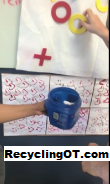
I described in my last post how I made a sensory pull toy. Today I videotaped a 2 year old using it while waiting for the horse and a 3 year old using it while on the horse. Another 2 year old who I did not catch on tape positioned in leg leg sitting to stretch her hamstrings- reached towards her toes to pull the rings. Another child did this activity while kneeling and another while standing.
Friday, April 27, 2012
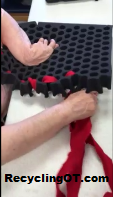
Sensory Pull Toy
Friday, April 6, 2012
No Longer A SECRET
Doreit Bailer and Lucy Jane Miller’s new book No Longer a SECRET: Unique Common Sense Strategies for Children with Sensory Motor Challenges elaborates on how to help the sensational kids Dr. Miller describes in her book Sensational Kids: Hope and Help for Children with Sensory Processing Disorders. Although a bit more technical, No Longer A SECRET is written by two expert occupational therapists for an audience of parents and educators eager to help children better access the curriculum, make friends and develop self-esteem.
I am going to compare the two books because although there is overlapping information, each offers readers a different perspective. Both books describes the sensory systems and subtypes of Sensory Processing Disorders (SPD)- which are as follows:
Purchase at Future Horizons
Use code "PEDIA" to receive 15% discount
or purchase on Amazon
I am going to compare the two books because although there is overlapping information, each offers readers a different perspective. Both books describes the sensory systems and subtypes of Sensory Processing Disorders (SPD)- which are as follows:
· Sensory Modulation Disorder
o sensory over-responsivity
o sensory under-responsivity
o sensory craving
· Sensory-Based Motor disorder
o postural disorder
o dyspraxia
· Sensory discrimination Disorder
Both books do an excellent job of explaining red flags and symptoms of SPD and how the concepts that make up the acronym “A SECRET” are used to problem solve solutions. The elements of A SECRET are:· A- Attention
· S-Sensation
· E-Emotional Regulation
· C- Culture, Context or Current Conditions
· R- Relationships
· E- Environment
· T- Task
Sensational Kids provides very detailed and lengthy case studies of sensational children, their family dynamics and how a child’s coping abilities are reflective of his or her specific neurological make-up. Case-studies include:· a typically developing first-grader
· an over-responsive kindergartner
· an under-responsive second grader
· a sensory-seeking preschooler
· a dyspraxic third- grader
Readers of Sensational Kids learn about basic intervention techniques, special education laws that impact services, the prevalence of SPD and co-existing conditions such as attention deficit disorder or autism and what the future holds for these children. Now No Longer A SECRET delves further into problem-solving a child’s emotional, social and sensorimotor challenges by carefully differentiating the subtypes of SPD in order to individualize treatment and avoid cookie cutter “sensory diets”. Short case-studies are used to illustrate a child’s challenged area and then a chart is created with each element of “A SECRET” filled in. For example, one child who had melt downs during soccer games was supported in the areas of
· Attention- by giving him the job of calling out sports moves
· Sensation by jumping, wrestling, jumping or doing heavy work before sports
· Emotional regulation –by listening to positive, uplifting music on the way to the game
· Culture- being picked up early from school to do some self-esteem boosting before the soccer games.
· Relationships-parents positive attitude influenced how he felt
· Environment- visual cues used to help him better judge where he was on field
· Task- play with smaller group of players
Parents might find the information in this book overwhelming, but I think that it will be worthwhile to plug along and reread the sections that pertain to their child. Then share strategy ideas with the occupational therapist (who will hopefully, also read this book). This is a great read also for experienced therapists. There are descriptions of many simple, low cost, easy to implement adaptations that are variations of what OT’s typically have in their bag of tricks. For example, sitting on a readily available folded sweater can be used instead of a cushion and a pen cap might be an ideal fidget tool because it doesn’t have any distracting moving parts (….not to mention it looks “normal”).
After writing this lengthy book review, I hope that it is no secret that I highly recommend No Longer A SECRET. Parents, teachers and therapists will find this an important resource when planning strategies for children challenged by sensory processing disorders.
Purchase at Future Horizons
Use code "PEDIA" to receive 15% discount
or purchase on Amazon
Wednesday, April 4, 2012
Sensory Sock Manipulatives
I spent some time sewing this week making "sensory sock" bean bags that can be used in a variety of ways. They are made out of socks filled with either- sand, popcorn or lentils. (you can use many oterh materials including marbles, pennies, beansetc. )
These bean bags feel really nice and of course can be used in toss activities. But I thought it would be interesting to create a manipulation activity using these familiar and inviting materials. 
The kids I work with are too young to expect to close buttons or snaps. However, one girl opened the snaps and another opened a knot. These are the first steps to learning how to manipulate fasteners- watching me do it in a fun way....The blue towel shown in the photo and video has pockets sewn onto them. I bought the pockets at a dollar store, but I can't rembmer exactly what they were, maybe potholders.
I can position the towel close in front of the child or higher on the mane to make the child reach during insertion tasks. When I place the towel behind on the horse's croup the child (and the child is facing forwards) has to rotate to place objects inside the pockets. Positioning the child to face sideways works on different postural stability and balance skills- while reaching for and inserting the socks.
I also teach color identification or directionality concepts when I tell the child to place the socks or toys in the red or blue, left or right pockets. I worked on matching skills when I asked the children to help me find matching color socks to connect before putting the materials away. (I did all the connecting manipulations).
Using these long and awkward socks is great for encouraging children to use both hands. So if you don't want to spend time sewing, try using these "sensory sock" activities during simple placement or tossing tasksIf you don't have a horse available- try adapting these activities to perform while sitting on a bolster swing-placing the towel in front of or behind the child. Reinforce with a little movement as needed during the task and then lots of movement when compelted.

Tuesday, March 27, 2012
Happy Mealtimes with Happy Kids- a book Review
I am listening to Dancing in the Kitchen as I write this book review, so I can’t help but be happy and enthusiastic like Melanie Potock, MA, CCC-SPL, author of Happy Mealtimes with Happy Kids: How to Teach Your Child About the Joy of food!Readers will learn that a cheerful and calm approach to child rearing challenges is the first step in teaching children to try new things, including food and this all leads to developing learning, flexibility and self-esteem. Melanie’s sunny side is contagious as she guides parents who might be stressed from
• teaching a medically fragile child how to bite, chew and swallow for the first time after months or years of tube feeding
• trying to help a sensory defensive child tolerate the touch, smell and taste of food on hands, face and inside the mouth
• dreading daily emotional mealtime battles
Happy Mealtimes is a parent friendly read that packs a lot of punch in just 118 pages. Written for busy parents who don’t want to learn how to be therapists, each chapter concludes with an even quicker to swallow and digest summary of the chapter’s 3-4 major concepts.
Parents will learn the basics of
• positioning for adequate support
• type of spoon to choose
• the developmental sequence of self-feeding beginning with making a mess!
• the importance of straw drinking
• how to recognize which behaviors are being reinforced
• and lots of strategies that lead to small steady gains
I think that every first time parent should read this book just to learn the basics of behavior modification. I myself grew up with a mom who allowed me to play with my food as the rest of my family ate, then throw out the bulk of it and eat ice cream. This is how you reinforce eating junk food!
My parents cheered me on when I pretended that I was a bird eating spaghetti “worms” –reinforcing again playing with food when I was perfectly capable of eating it and what would Miss Melanie say to parents who allowed their kids to watch television during meals and only served canned vegetables? (well, this was the 1960s….) I think she would have helped my mom learn how to create a fun, social environment that reinforced eating healthy, yummy foods. In an ideal world every new parent would have a Miss Melanie teaching them child development 101. Fortunately, if they can't have the real Melanie, they can at least buy Happy Mealtimes with Happy Kids….. Happy reading!
Check out Melanie's website for info on ordering books and her speaking events.
Mymunchbug.com
Subscribe to:
Posts (Atom)